






Octopuses
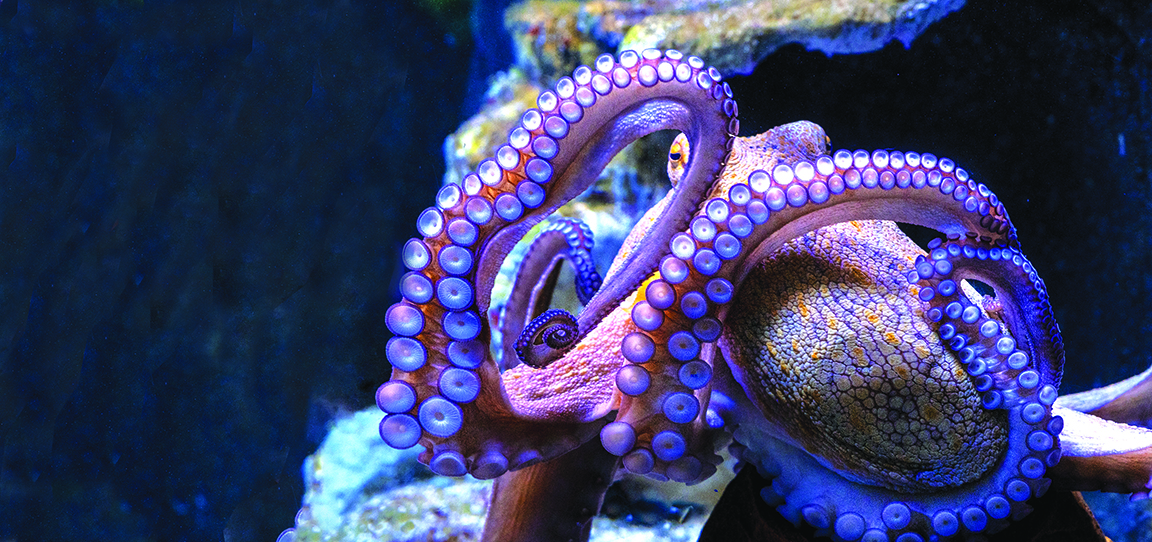
An octopus can change to camouflage itself so well it is almost invisible. It lives in every ocean in the world and can swim up to 25 miles an hour! It can stay out of water for up to an hour and because it doesn't have bones it can fit into any hole or crack that is no larger than its beak. This curious animal can live for two to four years and there are almost 300 different species of octopuses. As for the argument about octopuses or octopi, we are sticking with octopuses. That is how it has been since ancient times and I am not going to win an argument with the ancient Greeks who originally invented the word.
Just so we know what exactly we are talking about here, an Octopus is not a fish. It is a cephalopod. Cephalopods are invertebrate animals. That means they have no backbone. It is related to a much larger group of animals than you can imagine. Snails, slugs and clams are distant cousins. Closer relatives include squid and cuttlefish. An octopus has no bones, three hearts and a huge brain. Of course we can’t forget eight tentacles. Did you know two of those are legs and the other six are arms? The tentacles are covered with hundreds, even thousands of suckers that help an octopus hold onto its prey. Fun fact: if an octopus loses an arm it will grow back, or regenerate. Octopuses also have blue blood.
Octopuses have been around for a very long time. As a matter of fact the oldest known octopus was found in Bear Gulch Montana. The fossil that was discovered in 1922 was carbon dated and is 330 million years old. The fact that they outlived the dinosaurs, and survived to live after Bear Gulch, gives us an idea about how easily they adapt to changing environments. As a matter of fact as we watch fishing, pollution and the rising temperature of the oceans endanger many of the ocean’s animal population; octopuses are doing just fine.
One reason that this animal has been around for so long is it has developed amazing survival techniques. Octopuses have a beak that is very strong. They use the beak to chomp down on prey and enemies. Once octopuses chomp down they inject toxin into them. Every octopus has toxin, but only one is deadly to humans. That is the blue ringed octopus. An octopus also has the amazing ability to create ink. When the animal is startled it releases this ink as it swims away. This defense mechanism disorients the predator and allows the octopus to get away. Fun fact: some chefs use octopus, squid or cuttlefish ink to color food, especially if they want the food to appear black. The most fascinating defense is the ability to disappear right before your eyes. Most octopuses can control the chromatophores under their skin and literally fade into the background. This isn’t like a chameleon that just changes color. An octopus can also change its texture. In a matter of seconds an octopus skin can go from smooth to bumpy.
Octopuses can come in many shapes and sizes and they live in a variety of habitats. The Pacific Ocean is home to both the largest and smallest of the octopuses. The Giant Pacific Octopus can grow as big as 29 feet wide and can weigh 44 pounds. The Star-sucker Pygmy Octopus is about the size of the cap on a bottle of soda and is the smallest of the octopuses. The Blue Ringed Octopus can make its rings flash on and off like a neon sign. Even though it is quite beautiful it is considered the deadliest octopus. Other unusual animals in this family include the Dumbo, the Mimic and the Coconut Octopuses. How can this not be one of your favorite animals?