









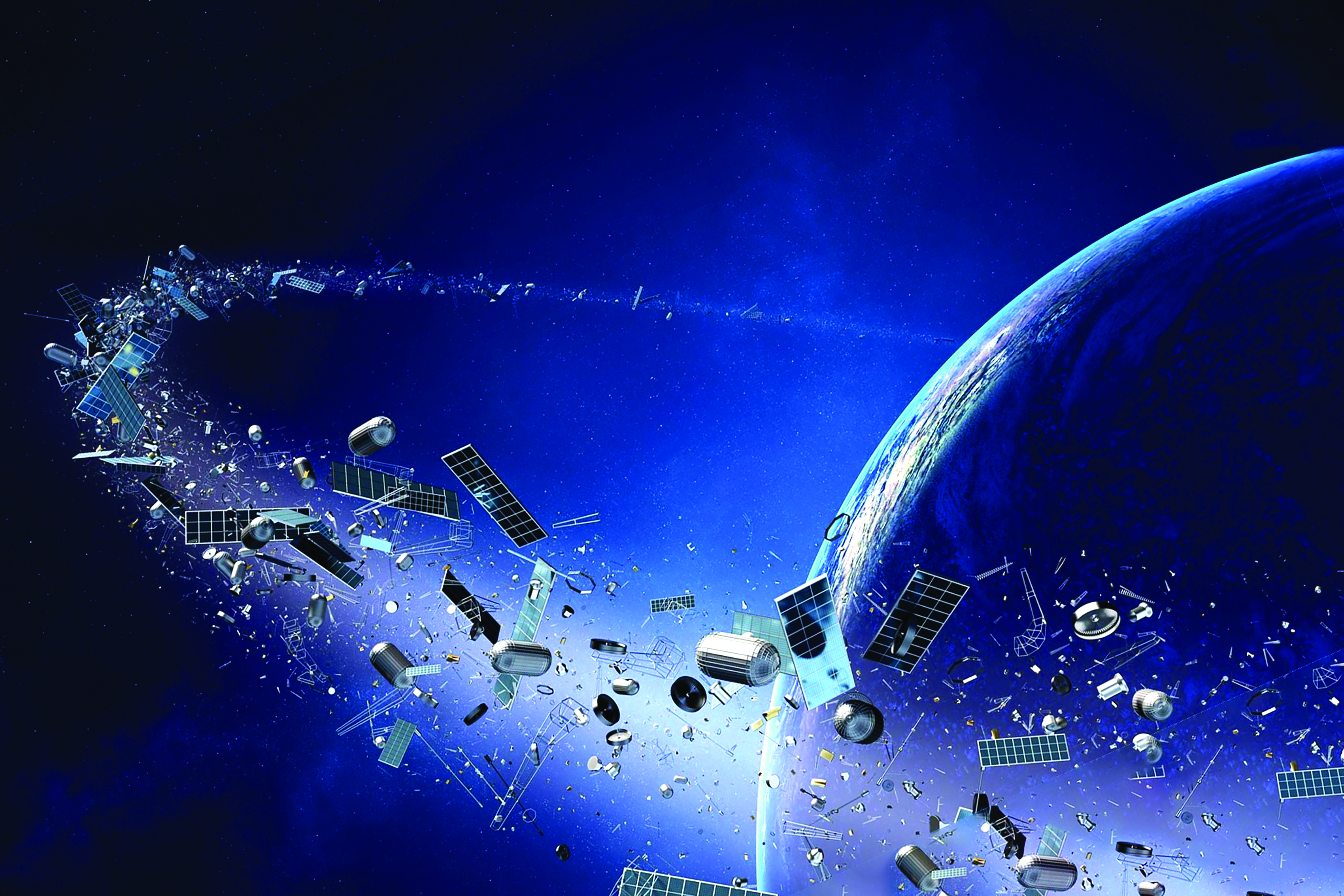
Space Junk
Space is like a giant playground, and in this playground, we have all kinds of cool stuff like satellites, space stations, and rockets that humans have sent up there over the years. But, just like in a regular playground, when people leave trash behind, it becomes a problem. Space junk is like that trash, but floating around in space. It’s all the leftover bits of rockets, old satellites, and pieces of things that humans have sent into space, and now they’re just kind of floating around in lower earth orbit. Space junk includes tiny paint flecks, old rocket parts, busted satellites, or even old tools astronauts might have lost during spacewalks. It can be anything that’s left up there and is no longer working.
Low Earth Orbit (LEO) is a region in space where satellites and the International Space Station (ISS) travel. It's not too far from Earth—only about 100 to 1,200 miles up—so it's like the space "neighborhood" closest to us. Satellites in LEO can circle Earth quickly, taking only about 90 minutes to complete one trip around. Unfortunately low Earth orbit is also where most of the space junk is.
Imagine you’re trying to play a game of tag in that giant space playground, but there are all these flying pieces of junk speeding around. Space junk moves fast, as fast as 17,500 miles per hour. At those speeds, even small pieces of space junk can be like little missiles and at those speeds the junk will win the game of tag. Tag your it would not be a pretty thing. The Kessler Effect explains how dangerous space junk can be. Imagine that all this junk collides with other things in space. When it does, it can break apart into even smaller pieces, and those smaller pieces can go on to crash into other stuff, causing even more tiny pieces. This can create a snowball effect where more and more junk gets made and starts flying around. The Kessler Effect basically says if we don’t clean up some of this junk, space could become like a dangerous traffic jam.
So, what can we do to fix this mess? Scientists are already tracking space junk using special telescopes so that they can warn astronauts and satellites to move out of the way if something is coming too close. They are also creating satellites and rockets that can de-orbit themselves, which means they’ll fall back to Earth safely at the end of their life instead of just floating up there forever. Another idea being worked on is developing a robot that flies around in space picking up junk and bringing it back down to Earth where it can be destroyed. One exciting idea includes using powerful lasers to zap space junk, making it burn up in the atmosphere.