









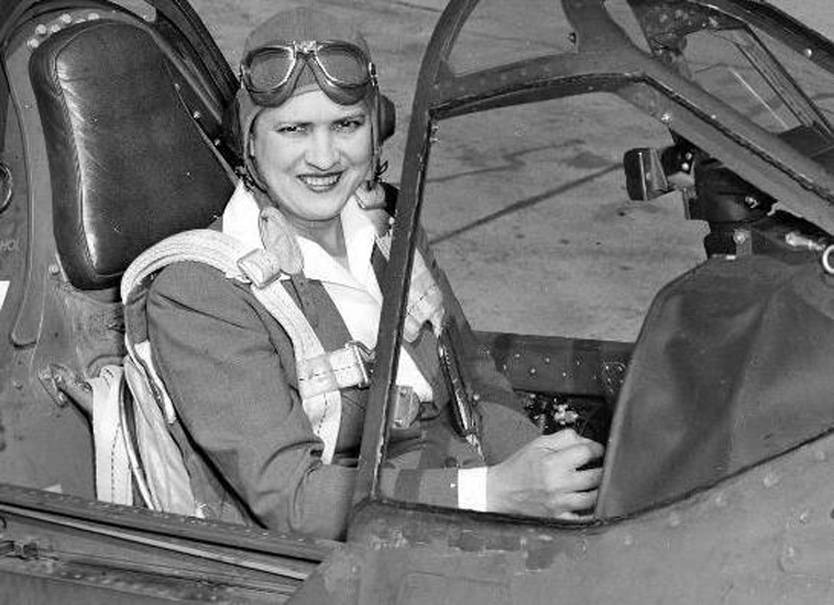
Jacqueline Cochran
Not too long ago people believed women did not belong in the cockpit of an airplane. It was during that time when Jacqueline Cochran changed the world’s opinion and became one of the greatest pilots in history. She set records and broke down barriers. She refused to accept the limits people tried to place on her because she was a woman. To her, flying felt like freedom. She set speed, distance, and altitude records that amazed even the most experienced pilots. Jackie wanted to prove that women could fly just as fast and just as skillfully as men. She soared past her own expectations and rewrote the history of women in aviation.
She won one of the most famous races in flying history, The Bendix Trophy Race. In this race pilots flew aircraft across the United States. They battled weather, stress, and exhaustion in order to be called the best pilot. Planes had no navigation systems and you had to fly close enough to the ground and stick your head out of the window to see where you were going. At that time it took about 16 hours by plane to fly from Burbank, California to Cleveland, Ohio. On a normal day in modern planes it takes about 4 hours to fly that same route. Jackie Cochran was the only aviatrix, (female pilot) to fly in the Bendix that year. Think about it, her drive to be the best woman pilot in the world led Jackie to win a race across the country against men.
During World War II, Jacqueline Cochran helped create the Women Airforce Service Pilots, or WASPs. The WASPs flew military airplanes to ports where they were loaded on ships and taken to places where they were needed. This left male pilots available to fight during the war. The women tested new and repaired aircraft including bombers. At first, many people didn’t think women should fly military planes, but they soon realized they were wrong. There were more than a thousand WASPs and although 38 women died during the war, they played a large part in the United States gaining air superiority.
Luckily Jackie lived through the war and in 1953, with the help of her good friend, Chuck Yeager, she became the first woman to break the sound barrier. That means she flew a powerful jet faster than the speed of sound. The shockwave, called a sonic boom, proved she had gone beyond what many people thought was possible. She lived a life showing the world that courage and determination can make any dream come true. We don’t learn about Jaqueline Cochran in history classes, but we should. She should be honored for what she did and who she was. By breaking records, leading others, and opening doors for women, she became a hidden hero that people should look up to.