






Aurora
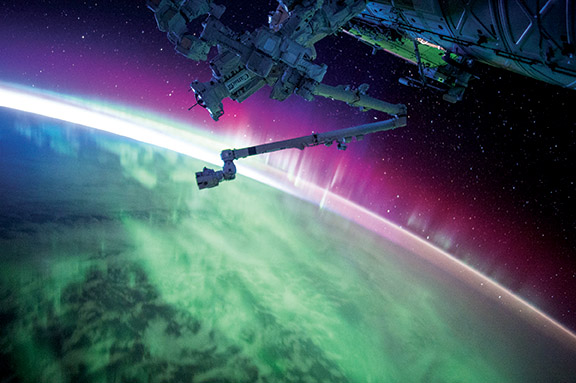
What is the connection between the words Arctic, Antarctic, Solar Winds and Magnetosphere? What do they mean and what out of this world phenomenon do they create? What is an aurora? Where can they be seen? As long as life on Earth has existed the Auroras have caused fear, wonder and fascination. The beautiful dancing lights are the focus of indigenous people in both the southern and northern hemispheres. Legends have been passed from generation to generation trying to explain them. This week we are going to bounce from Earth to the Sun to find out.
The Northern Lights and the Southern lights both have scientific names. They are the Aurora Borealis and the Aurora Australis. These lights begin their dance in the regions of the North and South poles. They can be seen for hundreds of miles. The Auroras happen at any time during a day. Their light is not very bright so most of the time they can not be seen when the sun is out. The lights in the southern hemisphere are shades of red and orange. Most of the myths and stories told by the Aboriginal people from Australia relate the lights to fire. In the northern hemisphere most of the stories are about life and death. Their name comes from the Roman goddess Aurora who was the goddess of dawn who brought light to the sky.
It wasn’t until 1899 when a scientist explained for the first time what an aurora was and how it was created. Kristian Birkeland was from Norway where the Aurora Borealis is very visible. His Norwegian Polar Expedition set up observatories that measured the magnetic field near the North Pole. He found that the stronger the magnetic field was the brighter the aurora became. Many people tried to disprove Birkeland’s theory but 60 years later, in 1963, the United States Navy proved him right. They launched a satellite into the ionosphere that had a magnetometer on board. Scientists on the ground studied the data and proved the magnetic currents, or Birkeland currents, really do exist.
The Earth has a protective magnetic field around it. This is also called a geomagnetic field. The area around the earth that is protected is called the magnetosphere. The sun puts out solar winds that carry charged particles. Most of the time the magnetosphere protects us from those particles. Sometimes particles slip past the magnetosphere. The particles are like a speeding truck that crashes into our atmosphere. As the crash happens light is released. The amount of different atmospheric gasses is what causes the different colors. High levels of oxygen cause green lights. High levels of nitrogen turn the lights into beautiful blues and purples.